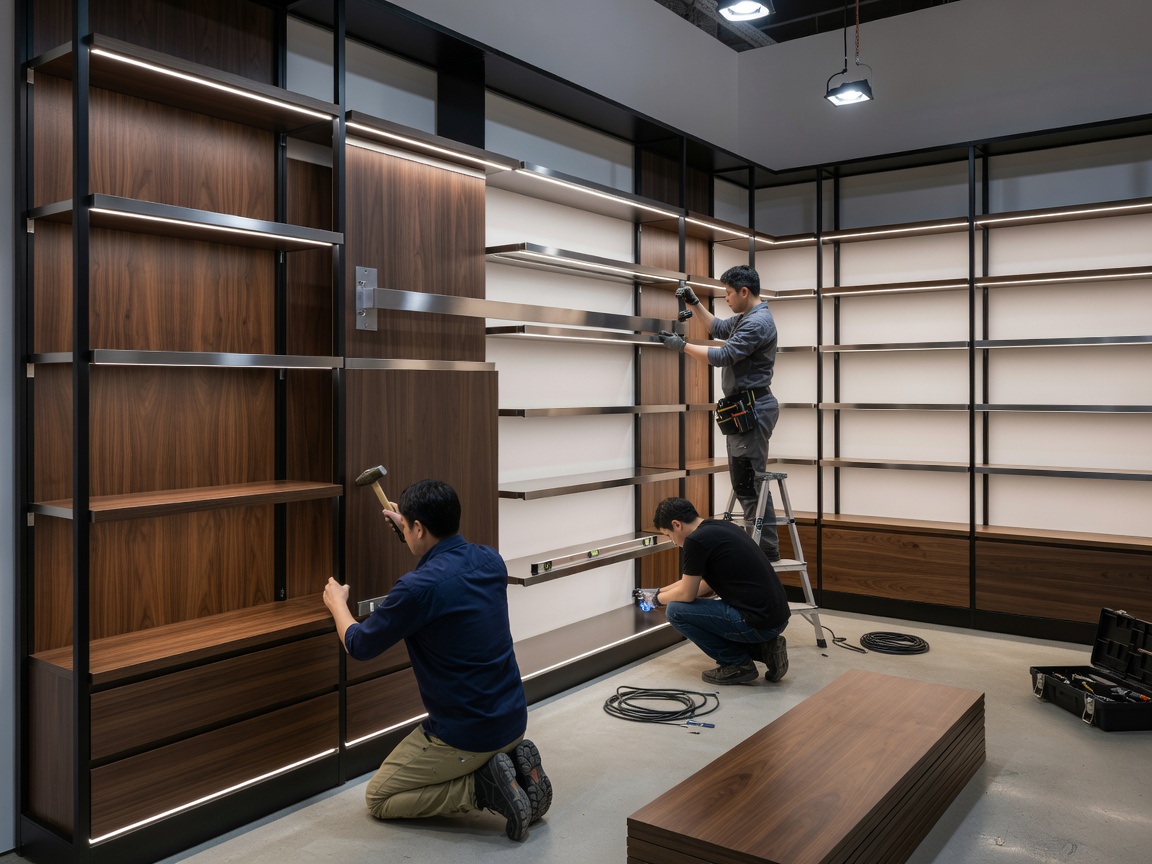
The Technical Demands of Modern Retail Fixtures
Retail display systems have evolved far beyond simple steel shelving bolted into walls. Today's commercial fixtures are intricate hybrids of CNC-machined oak veneers, cold-rolled powder-coated steel extrusions, low-iron tempered architectural glass, and integrated 24-volt constant-voltage LED illumination tracks.
When an installation crew treats these assemblies like crude flat-pack furniture, the results are immediately evident: mitre joints gap open, illuminated shelf brackets flicker due to misaligned busbar contacts, and cash-wrap sliding drawers bind against uneven subfloors.
We view fixture installation as precision mechanical engineering. Our team operates with precision digital spirit levels calibrated to 0.1° accuracy, micro-shim assortments, and specialized suction equipment for handling heavy display glass without edge chipping.
Critical Fixture Assembly Checkpoints
- Slotted Upright Plumb & Pitch: Verifying vertical alignment across multi-bay configurations to prevent shelf binds or bracket rattle.
- Busbar Current Continuity: Testing electrification paths in powered shelf uprights before hanging timber or glass merchandising decks.
- Drawer Runner and Hinge Tuning: 3-axis adjustment of soft-close Blum/Grass drawer slides and concealed Euro-hinges on service counters.
- Concealed Wire Management: Route cables through designated internal chaseways with strain relief to avoid pinched insulation during shelf adjustments.
Cash Desk Wraps and Architectural Feature Units
The payment counter or cash wrap represents the highest concentration of technical services in the entire store. It must securely accommodate EFT-POS terminals, fiscal printers, anti-theft deactivation coils, barcode scanners, and emergency power cutoffs, all while presenting an immaculate, flawless architectural facade to exiting patrons.
We sequence cash-desk assembly in strict operational layers:
- Sub-frame leveling: Structural anchoring of the base plinth onto the floor, shimming to true level regardless of subfloor undulation.
- Core service rough-in: Ingestion of data drops, dedicated power circuits, and telecom links before interior carcases are locked.
- Cabinet carcase interlock: Cam-lock and connector-bolt binding of individual sections with continuous visual inspection of flush seams.
- Solid surface / Stone top installation: Precision bedding of quartz, Corian, or hardwood countertops with matched silicone perimeter expansion joints.
| Fixture Category | Primary Installation Challenge | Quality Control Standard |
|---|---|---|
| Perimeter Wall Systems | Uneven historical masonry; wall out-of-plumb | ≤ 1mm gap across 3-meter continuous runs |
| Mid-Floor Gondolas | Dynamic stability; preventing tipping under load | Base ballast confirmation and floor anchors verified |
| Illuminated Vitrines | Concealed driver heat dissipation; wiring pinch | Driver ventilation clearance > 50mm; thermographic check |
| Fitting Room Joinery | Heavy door swing loads and privacy acoustic seal | Hinge cycle test (50 cycles); zero reveal sagging |
Preventing Finish Damage During High-Tempo Fits
Even the most accurately fitted fixtures can be ruined if crews do not respect delicate surface finishes. We enforce strict anti-scratch protocols across our work sites. Powder-coated metal surfaces remain wrapped in low-tack protective films until dusty cutting and drilling operations conclude.
Tools are never placed directly on unwrapped wooden or solid-surface tops; instead, rubberized work mats and tool-belt holsters are mandatory. By maintaining meticulous cleanliness and surface protection, we eliminate the need for costly French polishing and powder-coat touch-ups on opening day.
High-specification fixtures requiring specialized assembly?
Our master joiners and fixture assembly technicians execute demanding retail designs flawlessly.
Connect with Fixture Specialists